
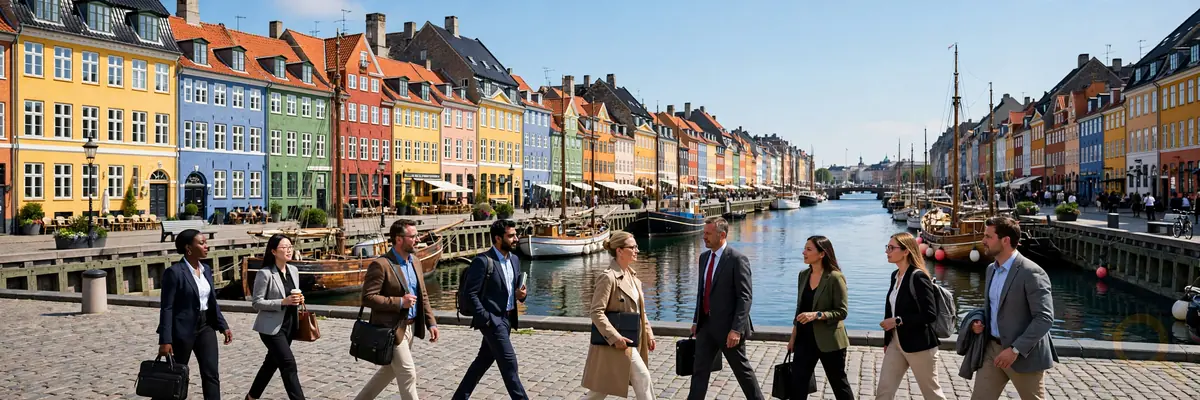
Denmark is one of Europe’s richest and best-organised labour markets, with world-leading employers in pharmaceuticals, green energy, shipping, engineering and tech — and one of the clearest permit systems for non-EU workers. Instead of points or vague criteria, Denmark runs on salary thresholds and shortage lists published by SIRI, the Danish Agency for International Recruitment and Integration. The headline figure for 2026: the Pay Limit Scheme requires a job offer of at least DKK 552,000 per year, roughly DKK 46,000 a month, with a Supplementary Pay Limit of DKK 446,000 under stricter conditions, and two Positive Lists that open the door for shortage occupations below those salaries. There is no labour-market test on the main schemes; if your contract is genuine and the money is right, the permit follows. This guide explains realistic salaries in Danish kroner, living costs, how each scheme works, the documents you will need, common mistakes, and the step-by-step application process.
Why Denmark?
Denmark pairs very high wages with the famous “flexicurity” model: employers can hire and fire relatively easily, but workers are protected by strong unemployment insurance, collective agreements and active retraining — and foreign employees under the permit schemes are covered by Danish employment standards from day one. Working weeks are typically 37 hours, five to six weeks of holiday is normal, work-life balance is taken seriously, and English is so widely spoken that many international companies, universities and start-ups use it as the office language. Copenhagen is the hub for pharma, biotech, fintech and shipping; Aarhus and Odense add tech, robotics and logistics; Esbjerg anchors offshore wind and energy; and the “Medicon Valley” cluster around the capital is one of Europe’s biggest life-sciences regions. Permit holders can bring family, partners receive the right to work, and after several years of residence and employment you can work toward permanent residence — Denmark’s rules there are strict (including Danish language and full-time work requirements), so treat it as a long-term project worth planning.
Cost of Living in Denmark
High salaries come with high prices, especially in Copenhagen, where a one-bedroom apartment commonly costs DKK 11,000–16,000 per month and competition is intense; in Aarhus, Odense or Aalborg, DKK 7,500–11,000 is more typical, and employer hubs in smaller towns are cheaper. Public transport passes run roughly DKK 500–800 a month depending on zones, cycling is free and genuinely the fastest way around most cities, groceries for one person typically cost DKK 3,000–4,000 a month, and eating out is expensive — a casual main course often costs DKK 150–250. On the plus side, many Danish contracts add a substantial employer pension contribution (often 12–18% of salary in total pension schemes) and the holiday allowance system (feriepenge) adds 12.5% for holiday pay — ask how your package is structured. Childcare is subsidised, healthcare is tax-funded, and after the first expensive months most professionals find the overall balance — pay versus costs — among the best in Europe.
In-Demand Job Sectors in Denmark
- Pharmaceuticals & Life Sciences: Denmark’s pharma and biotech giants and their supplier networks hire scientists, engineers, quality and validation specialists, and production staff at very large scale, especially around Copenhagen and Kalundborg.
- Green Energy & Engineering: Wind power manufacturers and developers, grid and construction engineers are recruited for onshore and offshore projects; electrical, mechanical and civil engineers are perennially short.
- IT & Technology: Software developers, data engineers, cloud and cybersecurity specialists are hired by banks, public digitalisation suppliers, start-ups and the big product companies, mostly in English-speaking teams.
- Healthcare: Regions and municipalities need doctors, nurses and other health professionals; authorisation by the Danish Patient Safety Authority and Danish language skills are normally required for clinical roles.
- Shipping & Logistics: Copenhagen’s shipping cluster and nationwide logistics operators hire maritime professionals, supply chain specialists and warehouse/transport staff.
- Construction & Skilled Trades: Electricians, plumbers, welders and other trades appear on the skilled Positive List as housing and infrastructure projects compete for labour.
- Food Production & Agriculture: Meat and dairy processing, food technology and farming hire production staff and specialists — roles where some schemes and the skilled list can open doors below the main pay limit.
Average Salaries in Denmark (2026)
Typical annual gross salary ranges in Danish Kroner (DKK):
- Food production / warehouse worker: DKK 380,000–470,000 per year
- Hospitality staff (chef, service): DKK 360,000–480,000 per year
- Skilled trades (electrician, plumber): DKK 480,000–620,000 per year
- Registered nurse: DKK 480,000–620,000 per year
- Engineer (mechanical, electrical): DKK 600,000–800,000 per year
- Software developer: DKK 620,000–850,000 per year
- Pharma / life sciences specialist: DKK 650,000–950,000+ per year
Denmark has no statutory minimum wage: pay and conditions are set by collective agreements, and SIRI checks that your salary and terms correspond to Danish standards for the occupation — an offer that undercuts the going rate will be refused even on a Positive List case. For the threshold schemes the figures are exact: DKK 552,000 per year for the Pay Limit Scheme and Fast-Track pay-limit track in 2026 (reset every 1 January from wage statistics), and DKK 446,000 for the Supplementary Pay Limit Scheme, which additionally requires that the job was advertised and applies only while unemployment is low. Note carefully what counts toward the threshold: SIRI looks at the salary paid into your Danish bank account, and items like free housing, car or one-off bonuses generally do not count unless they are fixed, guaranteed parts of pay — a common trap covered below.
Work Visa Options: How It Works
All non-EU work permits are combined residence and work permits processed by SIRI, with an application fee of DKK 6,810 for the main employment schemes. The Pay Limit Scheme is the flagship: any occupation qualifies if the annual salary is at least DKK 552,000 (2026) and terms are Danish-standard; no degree is formally required, though in practice these are professional roles. The Supplementary Pay Limit Scheme lowers the bar to DKK 446,000 but adds conditions — the vacancy must have been advertised in Denmark and the scheme is only open while unemployment stays below a set level. The Positive List for People with a Higher Education and the Positive List for Skilled Work cover named shortage occupations (the lists are updated every 1 January and 1 July and together carry well over 200 job titles): if your exact job title is listed and your qualifications match, no pay-limit salary is needed, but pay must still meet Danish standards for that occupation. The Fast-Track Scheme lets SIRI-certified employers (typically larger companies) start you quickly, with the same pay-limit salary, and includes tracks for researchers and short assignments. There are also schemes for researchers, PhD students, and certain trainees. Permits are usually granted for up to four years under the Positive Lists and up to two years initially under the pay-limit tracks, tied to the named employer and job — changing employer means a new application. EU/EEA and Swiss citizens simply register for an EU residence document instead.
Documents You Will Usually Need
- Valid passport and biometric capture (photo and fingerprints) within the set deadline after applying
- Signed employment contract stating salary, duties, hours and start date that meet Danish standards
- Documentation of education and qualifications matching the job (for Positive List cases, your title and training must match the listed occupation)
- Detailed CV and evidence of relevant work experience
- Proof that salary will be paid into a Danish bank account (required once you arrive)
- For healthcare and other regulated roles: Danish authorisation from the competent authority
- Case order ID and fee payment (DKK 6,810) created in SIRI’s online system before submitting the application
- Family documentation (marriage and birth certificates, legalised/translated) for accompanying family applications
How to Apply: Step by Step
- Identify your scheme: Pay Limit (DKK 552,000+), Supplementary Pay Limit (DKK 446,000+ with conditions), Positive List, or Fast-Track via a certified employer.
- Apply to genuine employers through the portals below and get a signed contract that meets the scheme’s exact salary and Danish-standard terms.
- Create a case order ID on nyidanmark.dk, pay the SIRI fee, and complete the online application (AR1 form, usually filled in jointly by you and the employer).
- Submit your passport copy and supporting documents online; the employer submits their part in parallel.
- Record biometrics at a Danish mission, police station or visa application centre within the deadline (usually 14 days from submission abroad).
- After approval, travel to Denmark, register your address to receive your CPR number, open a Danish bank account for salary payment, and collect your residence card.
Trusted Job Portals for Denmark Jobs
- Jobnet (jobnet.dk): The official Danish public job service, listing vacancies across all sectors.
- Jobindex (jobindex.dk): Denmark’s largest job portal, covering professional, technical and service roles.
- Indeed Denmark (dk.indeed.com): Aggregator with broad coverage including English-language postings.
- LinkedIn (linkedin.com): Essential for pharma, tech, shipping, engineering and international company roles.
- Work in Denmark (workindenmark.dk): The official portal aimed at foreign jobseekers, with English-language vacancies and guidance.
- EURES (eures.europa.eu): EU mobility portal listing Danish vacancies and living/working information.
Practical Tips & Scam Warnings
- Permits are never sold: SIRI decides applications from genuine Danish employers; anyone offering to “arrange” a Danish permit or a fake high-salary contract for a fee is running a fraud that will end in refusal and a ban.
- Watch what counts as salary: Housing, cars, free food and irregular bonuses usually do not count toward the DKK 552,000 threshold — your fixed, guaranteed pay must clear it.
- Use official channels only: Rules, lists and thresholds are published on nyidanmark.dk; check your occupation’s Positive List status there for the current half-year.
- The contract must be Danish-standard: SIRI refuses offers below collective norms even under the pay limit — compare your offer with typical pay for the occupation.
- Never start before approval: You may not begin work until the permit is granted (Fast-Track has limited exceptions for certified employers); working illegally can void your case.
Common Mistakes to Avoid
The most frequent failure is a salary assembled from pieces SIRI does not accept — for example including the value of free accommodation, a company car or an unguaranteed bonus to reach DKK 552,000. A second is Positive List mismatch: your actual duties and qualifications must match the listed job title precisely, and the lists change twice a year, so a title that qualified in January may be gone in July. Applicants also lose cases by missing the biometrics deadline, by applying while the Supplementary scheme’s unemployment condition is not met, and by assuming they can switch employers freely — the permit is employer-specific, and starting a new job without a new permit is a serious breach. Healthcare professionals should start authorisation and Danish lessons early; clinical jobs without Danish are rare. Finally, remember that Denmark abolished its old Green Card scheme years ago: any website still selling “Denmark Green Card” applications is a scam signal.
Frequently Asked Questions
What is the minimum salary for the Pay Limit Scheme in 2026? DKK 552,000 per year, paid on Danish-standard terms into your Danish account. The threshold is reset every 1 January, and your application is judged by the level in force when you apply.
How long does SIRI processing take? Service goals are roughly one to three months depending on the scheme, faster for complete Fast-Track cases; incomplete files take longer.
Can my partner work in Denmark? Yes. Accompanying spouses/partners of permit holders normally receive a permit with the right to work, and children can attend Danish schools.
Do I need to speak Danish? Not for most pay-limit and tech/pharma roles, where English is standard. Clinical healthcare roles and many public-facing jobs require Danish, and it matters for permanent residence.
Denmark rewards foreign professionals who bring a correctly structured offer from a real employer. Match your scheme carefully, make sure the fixed salary genuinely clears the threshold, and Denmark’s system is fast, clear and fair in 2026.